
Tuesday, 16th June, 2026
Tuesday, 16th June, 2026
Will Bangladesh trade with EU come under pressure?

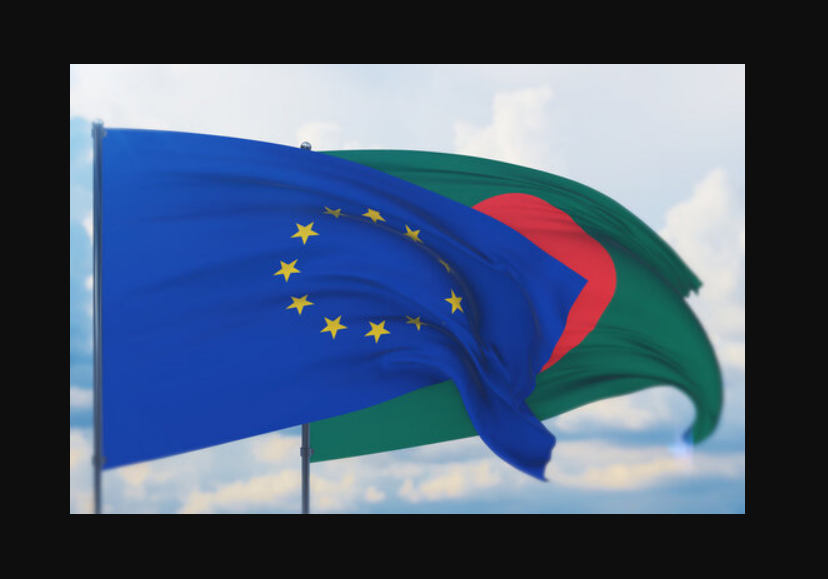
The European Union (EU) for a long time now has been a large market for Bangladeshi goods. And 27 EU countries are the destination of around 48 per cent of Bangladesh’s exports. The volume of annual exports is around USD 25 billion (USD 2,500 crore). As a result Bangladesh is well advanced when it comes to bilateral trade with EU.
Readymade garments constitute 93 per cent of Bangladesh’s exports to EU. Generalized System of Preference or GSP has placed the garment industry in a strong position over the past two decades. Even though Bangladesh will step up from and LDC status to a developing country in 2026, it will still receive this facility for three years after that. After that, in order to keep up the tariff-free facilities with EU, Bangladesh will have to attain GSP Plus (GSP+). This will not be possible under the existing rules and regulations and Bangladesh is negotiating with EU over the matter.
Amidst these circumstances, the European Union on Thursday expressed deep concern over the state of human rights in Bangladesh and resolution was taken up through voice vote. The resolution called upon Bangladesh to adhere to international standards to ensure civil and political rights. Additionally, the resolution highlights the importance of ensuring a safe and favourable working condition for non-governmental development organisations, human rights activists, and religious minorities.
The resolution mentioned that an Everything but Arms (EBA) enhanced engagement process remains ongoing with Bangladesh. But owing to its serious violations of international conventions, it is concerned that the Odhikar case is a regrettable step back, bearing consequences as to whether EBA preferences continue to apply to Bangladesh. Incidentally, HSP facilities are provided through EBA.
This correspondent on Friday spoke to a number of exporters concerning the resolution taken up by the European parliament. They said there was no cause for immediate alarm over trade and commerce with the EU. However, the questions raised in the European parliament regarding the continuation of GSP facilities, was certainly uncomfortable. They felt the government should take due note of this resolution taken up by the EU parliament.
Distinguished fellow of the Centre for Policy Dialogue (CPD), Mustafizur Rahman, when asked about this issue, said, the resolution adopted by the European parliament is a matter of concern. After all, this did not come out of the blue. Various persons within EU had raised these issues at various times. This resolutions came as a result of that. He said, “EU is a large partner in our export trade. They are big investors. They provide us with loan assistance too.”
EU is a big market for Bangladeshi goods. (The US is the largest importer of Bangladeshi goods as a single country.)
According to the Export Promotion Bureau, the volume of Bangladesh’s exports to the EU in the 2022-23 fiscal totaled USD 25.23 billion (USD 2,523 crore). Six years earlier, in 2017-18, it had been USD 21.33 billion (USD 2,133 crore). It went up by 7 per cent in the following year. Then exports fell due to the Covid outbreak. In 2021-22 fiscal, exports to this market revved up again.Among the EU countries, Germany is the largest market for Bangladeshi products. Last fiscal, 13 per cent of the exports, that is goods worth USD 7.08 billion (USD 708 crore) were exported to Germany. Next came Spain at USD 3.68 billion (USD 368 crore), France USD 3.29 billion (USD 329 crore), Poland USD 1.85 billion (USD 185 crore), the Netherlands USD 2.09 billion (USD 209 crore), Denmark USD 1.31 billion (USD 131 crore) and Belgium at USD 940 million (USD 94 crore).

Related Post


Recent
Popular


Editor: Ahsan Habib
Advisory Editor: Syed Ershad Ahmed
Published by the Editor from House: 41/1, Road:1, Block:A, Niketon, Gulshan-01, Dhaka:1212, Editorial Office: House-08, Road-37, Gulshan-2,Dhaka-1212
Phone: 02-9862635, 01785902626
Email: dailyeconomistbd@gmail.com,
editordailyeconomist@gmail.com
Developed by: Fagun Media & IT Communications Ltd.
Developed by: Fagun Media & IT Communications Ltd.